Every unit you service should call you back
When the AC quits on a July afternoon or the breaker keeps tripping, the person in the building calls whoever they find first. A ProTag sticker on the equipment makes sure that is you: they scan it, see your company, and reach your dispatch in one tap. Your techs scan the same sticker for the full service history.
Plans start at $499 a year. Nothing for your customer to install.
You did the install. Someone else got the service call.
Your best work is sitting on rooftops and in back rooms with nothing on it that says who to call. When it breaks, the customer starts from scratch, and you are one result among many.
The 84 degree afternoon
The AC quits and nobody in the building remembers who services the units on the roof. They search "AC repair near me" and call whoever answers.
The new manager
Your contact moves on. Their replacement inherits the building but not the phone list, and the relationship walks out the door with the old one.
The faded card
The business card taped to the furnace door, the marker on the disconnect. Gone by the second summer, and never in front of the person deciding who to call.
One sticker. Two jobs.
For your customer, it is the fastest way to reach you. For your techs, it is the service record. The second job is why the first one keeps working: a sticker your techs scan every visit is a sticker that stays on the unit and stays current.
Every screenshot below is the real product, not a mockup.
Your company, one tap away, on the unit that just broke
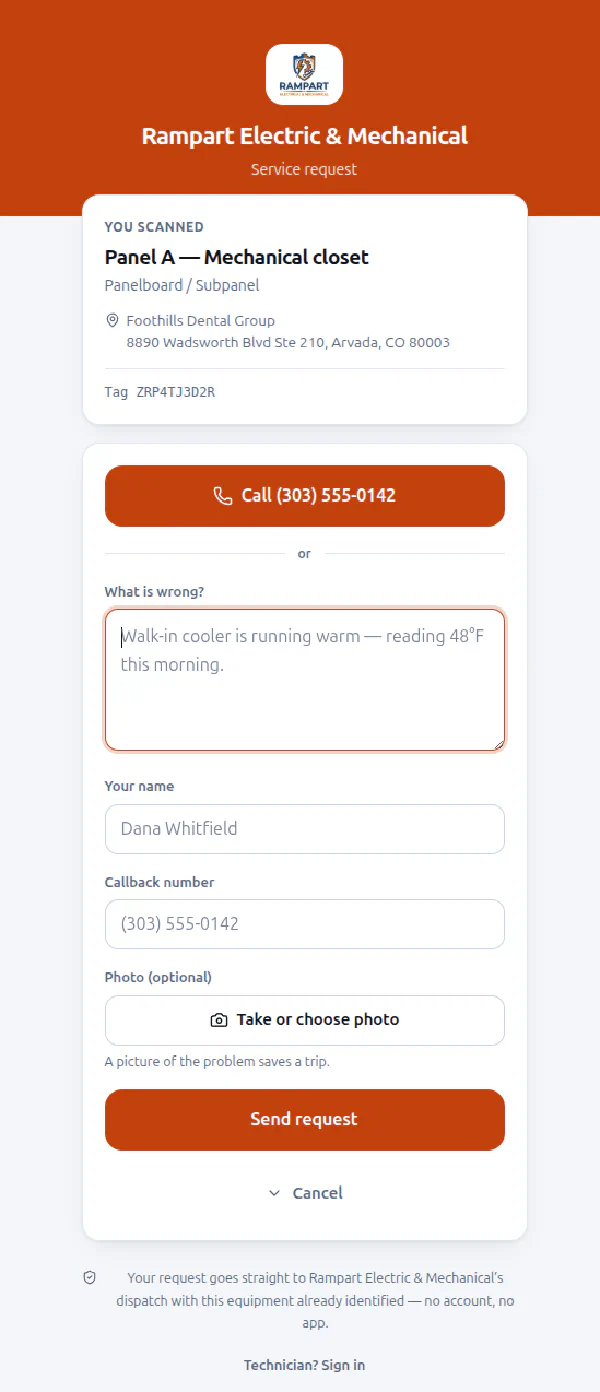
Your company name, your logo, your brand color, your dispatch number. One tap to call, or a short form that already knows which equipment it is and where it sits. No account, no app, no search results, no competitor's ad in between.
- Your branding on the page, not ours
- Request lands with equipment and address already attached
- A tag on the thermostat finds the rooftop unit that serves that room
- Photo of the problem, straight from their camera
The history only you have
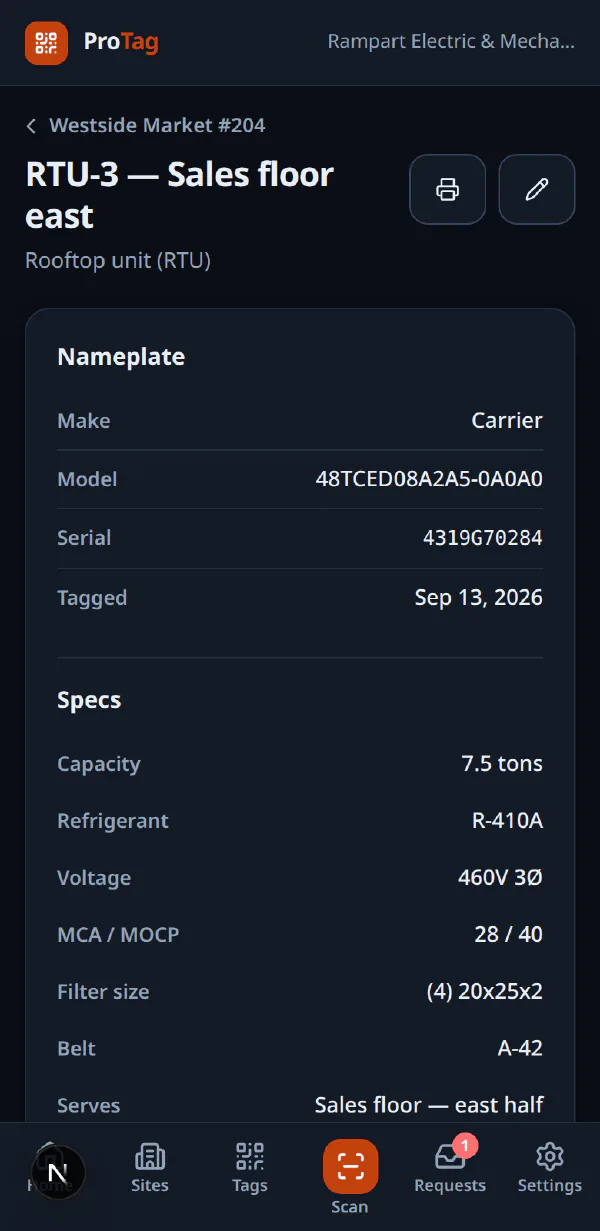
Same sticker, signed-in session. Nameplate, specs, every logged visit with photos, and what this unit is fed from. Years of it, on your account. That is a reason to call you that no other contractor can match.
- What the last tech found, in their words
- Model, serial, tonnage, refrigerant, filter and belt sizes
- Superheat, subcooling and amps, and how they moved since last visit
- Fed from and feeds, so you know what goes dark
Tag the whole room, not just the unit you came for
Every sticker is a future call. You are already standing in the mechanical room, so tag every RTU on the roof, the furnace, the air handler and the thermostats on the way out. It takes seconds each, and from then on every one of them points back to you.
Blank tags, set up on the spot
You do not have to know what a sticker goes on before you print it. Keep blank tags in the van, stick one on, scan it, and fill in the equipment right there.
- Print your own on 2 inch or 1.5 inch square label stock, with your company name and number on every label
- Or order printed weatherproof tags that scan straight to your branded page
- A human readable tag ID and the portal address under the code, so a scratched or greasy sticker can still be keyed in
- Tag the thermostat too: the people in that room scan it and the request lands on the unit that serves them
Records that make the next visit faster
Pick a category and the right spec fields appear. Record what feeds what while you are tagging, and any tech scanning a rooftop unit knows which disconnect and which breaker feed it, without a drawing or a call to the office.
- Snap the nameplate and make, model, serial and specs fill themselves in
- Reassign a tag when a condenser gets replaced
- Retire a tag when the sticker is destroyed, so scans stop resolving
- No drafting, no site survey, no separate diagramming tool
Tagged this morning, working for you for years
Add the site
Address, site contact, and the notes that matter: where the panel room key hangs, which door the alarm is on.
Tag the equipment
Stick a label on each unit and scan it. Name, category, nameplate. The right spec fields appear for the category.
Log every visit
Readings, parts, photos, refrigerant. Each reading shows how it moved since last time, and the next tech reads it all before they get out of the truck.
The next call comes to you
When something breaks, whoever is standing in front of it scans the sticker and reaches your dispatch, not a search engine.
When they call, you already know which unit
Requests from a scan arrive with the equipment, the site and a callback number already on them, so dispatch starts with the answer instead of twenty questions. Calls and emails get logged against the same unit, and urgent ones go to the top. Work them in ProTag alongside whatever you already dispatch from.
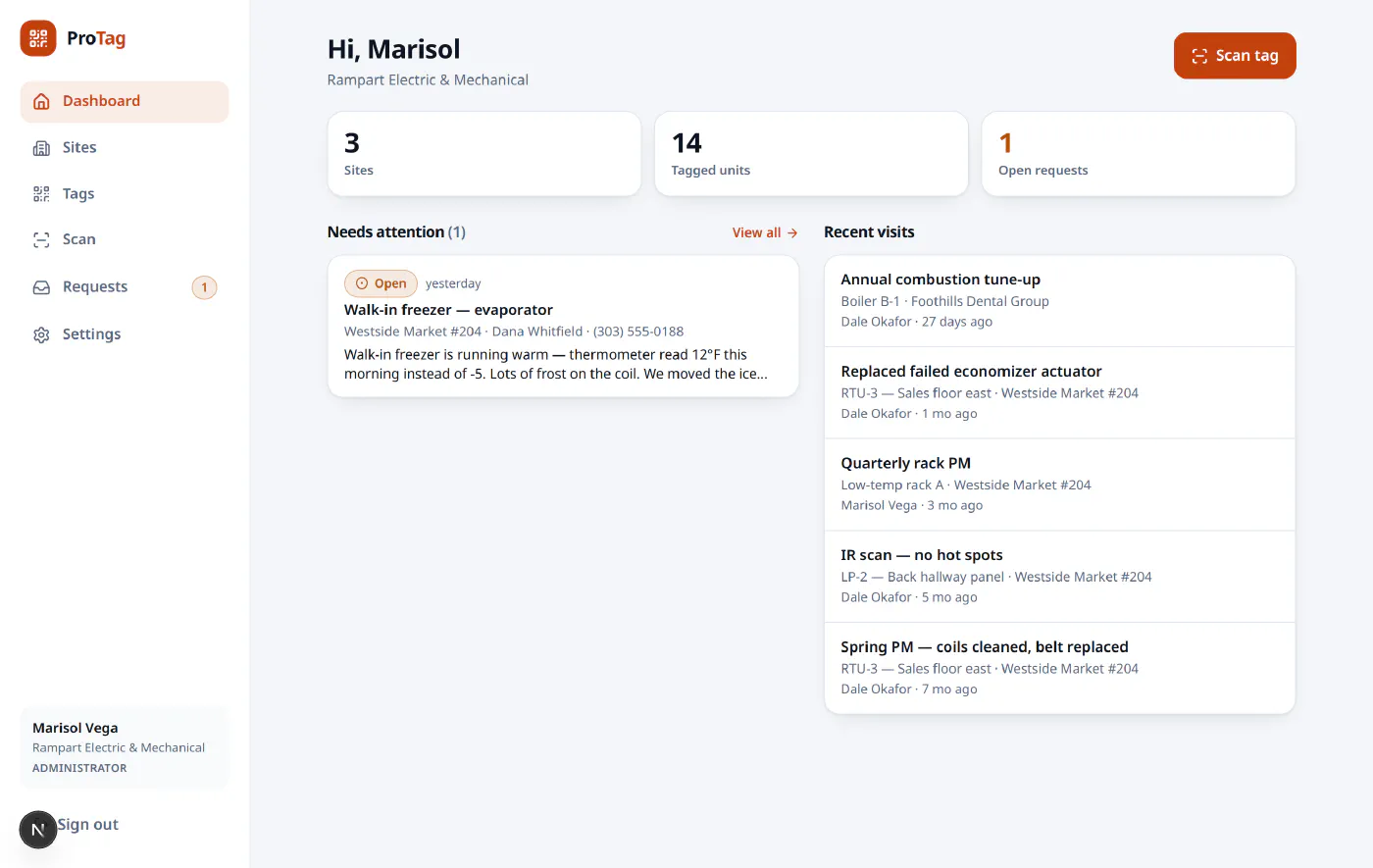
A real dispatch view, with demo data in it.
Turn the history into the next job
Every visit you log tells you something about the unit: how old it is, how often it breaks, what the repairs cost. ProTag puts that in front of the customer in a way that books maintenance and wins replacements.
Maintenance that comes due
Put a unit on a schedule and it shows up on the due list when its spring or fall tune-up is near, grouped by site. Warranties ending in the next 90 days are listed too, so you call the customer before the coverage runs out.
A report for the building owner
One tap on the site makes a branded PDF: what is on site, what needs attention, what is overdue and what to budget for. It is the thing you hand over at the end of a PM that makes the contract renew.
Replacements the customer approves
ProTag flags the units worth replacing, with reasons a facilities manager can take to a budget meeting: "16-year-old R-22 rooftop unit, $4,600 in repairs this year". Send a proposal from the unit and the customer approves it from their phone. The job lands in your queue.
Maintenance and warranties are on every plan. Branded site reports, replacement planning and proposals are on Pro and up.
Straight answers
Do my customers need an app?
No. The camera app on any modern phone reads the code and opens a web page with your name on it. There is nothing to install and no account to create.
Does it work for residential service?
Yes. Put a sticker on the furnace and the condenser. When the AC quits in August, the homeowner scans it and calls you instead of searching. Every tune-up you log builds the history, and the maintenance schedule tells you when the next one is due.
Can a competitor scan our tags and see our work?
No. Anyone scanning without a signed-in account sees only your branded service request page. Specs, service history and the feed chain require an account on your company's ProTag.
Does this replace our dispatch software?
No. ProTag is the sticker and the equipment record. Requests show up in ProTag, and on Pro and up they are emailed to your dispatch address too, so they reach the office wherever you already work. When a customer calls or emails instead of scanning, the office can log the request against the unit so it stays in that unit's history.
Does it keep refrigerant records?
Yes, on every plan. Record the full charge on the unit and what was added or recovered on each visit, plus any leak repair and its verification. ProTag works out the leak rate the way EPA's leak repair rule describes and flags units over their trigger. Export the log to Excel when someone asks for it. More on refrigerant tracking.
Will the stickers survive a rooftop?
Print on outdoor rated vinyl or polyester label stock and they hold up to weather, wash-down and UV. The tag ID is also printed in plain text underneath, so a damaged sticker can still be keyed in by hand.
What happens when we replace a unit?
Move the tag to the new equipment in two taps, or retire it and put a fresh one on. The old unit keeps its service history either way.
How do techs log in with gloves on?
They do not type anything. Techs sign in with a passkey: their face, their fingerprint, or whatever already unlocks the phone. Every phone is tied to a named person, so each visit in the service history carries the name of whoever actually did the work. Office staff on a password can turn on two-step verification with any authenticator app.
Tag your first site today
Create your account, print your first tags, and stick one on real equipment in the next ten minutes.